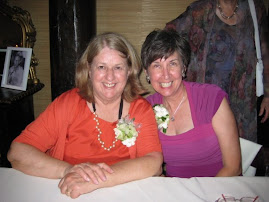
This year on Mother’s Day I had a slight case of the blues, due mainly to the thousands of miles that separate me from my adult children. But, I didn’t stay blue for long. In my 63 years of living (that's me second from the left, on my Dad's lap), I have learned several techniques for coping with the blues. The first is to put my thoughts to paper which usually leads me to my second coping mechanism which is clear thinking and the realization of how much I have to be thankful for and that I have no reason to be having a “pity party” as I call these periods of being down. When these strategies don’t work, I go out into the garden and exert my physical and emotional energies by digging up weeds, transplanting plants, mowing the grass or that most hated chore, spreading mulch.
What I like about the writing process is that I never know where it will lead me. This past week, as I was writing and reminiscing about my mother, I recalled an event that turned out to be revealing not only of my mother’s personality, but when viewed from today’s perspective, a bit of my own, as in “am I becoming my mother?” And “is that a good thing or a bad thing?”
Before I share the story, I need to give some background about my family and especially about my mother. In regard to both being a mother and having a mother, you could say that I fall into the ranks of the very fortunate. My children were born hale and healthy in mind and body; they grew up in a fine community; they had good opportunities for education; and as adults, they have grown to be kind, considerate men. My own mother was deeply devoted to her family. In fact, I was blessed to have a mother who for every day of my life up until her death at the age of 91, even when she was cranky and unable to care for herself, loved me unconditionally.
In order to fully understand who my mother was, it is vital to understand the strength and depth of her belief in the importance of manners as a formative part of the character of a person. She ingrained in all of us how important it was to exhibit courtesy and respect to every one we dealt with. We learned this in various ways. One of the ways we were expected to show respect was to dress and act appropriately for different occasions. At church, you could be sure that all the Saville girls would be donning hats and gloves and that we would not be fidgeting in the church pew. When it came time for holidays or birthdays, and all the gifts had been opened, there was no question that all four children would spend the hours necessary to compose interesting and timely thank you notes to all those who had been generous enough to remember us. We were taught to observe the strictest Emily Post etiquette while dining (e.g., serve on the right; take away on the left); by dutifully serving punch and cookies at women’s club meetings which my mother occasionally hosted in our home; by always saying “yes, ma’am” and “no, sir;” and by participating in any number of community service organizations where we interacted with people of all ages and social backgrounds. Some people dismiss such an emphasis on manners as being nothing more than a superficial concern about appearances. With my mother, I think it went deeper than that and that she genuinely believed that all people were worthy of respect, kind words, and fair treatment.
Another way we were taught to show respect was to willingly carry out any and all chores that would help our parents, our elders and our neighbors. My mom taught school from the time I turned six years old until her retirement, approximately 25 years in total. Combining the responsibilities of a full-time job with the parenting of four children, she became very good at delegating chores. She taught all of her daughters how to iron, vacuum, dust, wash dishes, sew and cook. Under the tutelage of my dad, my brother took care of the outside chores, mowing the yard and washing the car.
When the time came for my parents to experience the “empty nest syndrome,” I know that my mother had her share of days being blue and wishing that her four children were closer to home. But Mom had her own recipe for fighting the blues. My mom always had a project spread out on the card table in the living room. She was continually getting “organized.” For the first ten years after her retirement from teaching, she became a passionate genealogist. She worked with her sister, who was six years her elder, to research our family roots and to create a collection of documents that she later had bound and gave to all of her children as gifts. After those first ten years, she tackled the family photos, dividing them into albums by themes. There was one album for each child and one for each trip she and my dad made, either on Elder Hostel trips to different universities in the US or to different cities and countries where family members were residing at the time. After the photos, her next project was to sort through all the correspondence that she had saved from her children from locations as diverse as Louisiana, Germany, France, Viet Nam, Alaska, Oklahoma, Pennsylvania, and Texas and to divide the letters and store them in boxes, one for each of her four children. Finally, she took on the job of de-cluttering her basement, gradually giving away treasured pieces of china, family quilts, books and pieces of furniture or personal objects which over time have become family heirlooms. Thanks to all of these “projects,” each of us has in our homes today a plethora of artifacts of family history that are available to take us back in time whenever we feel the need-- letters, photos, genealogy books, the sleigh bells from my dad’s family farm, the pink cigar box from my mother’s father, and artwork that hung in prominent spots in my parents’ house.
In all of these activities in which my mom demonstrated that she was a born archivist and an organizer extraordinaire, she was motivated by one passion, i.e., to maintain order and cohesion in the family. It paid off at the time of her death, and even before that, when she and my dad left their home to move to a continuing care facility. Dividing up the family possessions was made much simpler because she had already made her wishes known to all of the family members. In other words, she maintained control and order in the family, even after her death, an amazing feat.
I never fully appreciated all of my mother’s efforts until much later in her life. There were times when I perceived her passion for perfection and order as annoying, going so far as to spark a small rebellion on my part when, at the age of 30, she was still reminding me to do this and that. In hindsight, I understand that this was her way of teaching us the importance of being a family and of sharing her hope that we would remain close to each other and be supportive of each other throughout our lives. I talked back to my mother only once in my life and it was on just this subject of telling me what I should and should not do. We usually came together as a family for the major holidays. One year at Easter, instead of going to my parents’ home, we decided to meet at a fine restaurant in the Washington, D.C., area, midway between all of our places of residence. There were at least ten of us seated at the long, elegantly-set table. Mom had just told me to not forget to send a birthday card to my 80 year-old aunt. When I did not respond to her, what I now recognize as a passive / aggressive behavior on my part, and she repeated her reminder, everyone at the table looked at me, stupefied and horrified by my abrupt and unkind outburst that she no longer needed to tell me how to behave, thank you very much. By some standards, this may seem incredibly mild as “back talk.” But for my family, it was paramount to slapping my mom in the face.
The reason I find this particular story so significant is that only one month ago, I emailed both of my children to tell them that my sister’s birthday was coming up and that it would be so nice if they remembered to send her a card. Are we starting to see a pattern here? To their credit, both of my sons responded by thanking me for the reminder. I wonder if I would have ever remembered this story if I hadn’t started writing about my mother on the day I was feeling blue about Mother’s Day. Thanks to my own personal therapeutic strategies, I experienced a sort of wake-up call, as well as a nostalgic blast from the past. So I’m starting to be like my mother? Is that really such a bad thing? Perhaps something I need to ponder on this Mother’s Day 2010. . .